Replying to
Looking forward to discussing ACASA-TAVI with this community.
Wouldn’t it be better to diagnose subclinical valve thrombosis first with CT followed bij randomisation of only positive patients to continuing ASA vs DOAC (POPULAR ATLANTIS)
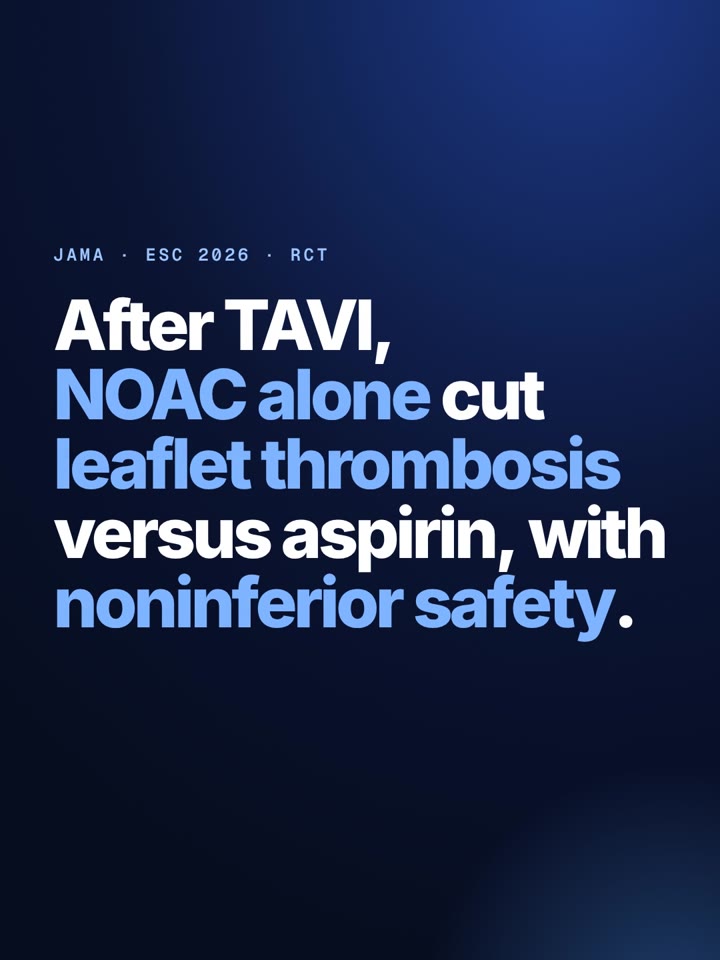
Key result
NOAC monotherapy after TAVI reduced HALT versus aspirin (16.2% vs 28.6% (27/167 vs 48/168)) with noninferior safety.
Why the trial?
The optimal antithrombotic regimen after TAVI is unsettled: aspirin is standard, yet leaflet thrombosis is frequent and its prevention unproven. ACASA-TAVI asked whether NOAC monotherapy protects the valve better without excess bleeding.
Does NOAC monotherapy reduce valve leaflet thrombosis and maintain safety compared to ASA monotherapy in patients aged 65-80 years undergoing TAVI for severe aortic valve stenosis?
| Outcome | NOAC | ASA |
|---|---|---|
| HALT (valve leaflet thrombosis) on 4D CT at 12 months | ||
| Co-primary efficacy · in-world sources disagree (abstract 16.2% vs 28.6%; structured record 17.2% vs 32.6%); values withheld pending review |
Safety
VARC-3 bleeding, thromboembolic events, or death (co-primary safety) occurred in 13 (7.5%) vs 19 (10.6%); RD −3.3% (95% CI −9.5% to 2.8%); noninferior (p<0.001).
Design limitations
In-world sources disagree on the primary HALT rates, so the efficacy result needs manual reconciliation.
Subgroup caution
HALT is a subclinical imaging endpoint; its link to clinical events is not established by this trial.
Representation
Findings apply to patients aged 65–80 without another indication for anticoagulation.
Does NOAC monotherapy reduce valve leaflet thrombosis and maintain safety compared to ASA monotherapy in patients aged 65-80 years undergoing TAVI for severe aortic valve stenosis?
Relative Risk: 0.55 (95% CI 0.37–0.82)
Absolute Event Rate: 16.2% vs 28.6%
p-value: p=.004
In patients aged 65-80 undergoing TAVI, NOAC monotherapy for 12 months significantly reduced subclinical valve leaflet thrombosis and was noninferior for clinical safety events compared to standard aspirin monotherapy.
Looking forward to discussing ACASA-TAVI with this community.
ACASA-TAVI co-authorCaptured external expert commentary on this trial, strongest first. Original sources are linked where available.
“We were able to show substantial reductions in signs of subclinical leaflet thrombosis with NOAC monotherapy, without compromising safety. Results from the ACASA-TAVI trial may establish a new antithrombotic treatment paradigm after TAVI and could be used to inform future guidelines.”
“@ShariqShamimMD @djc795 We will report 5 and 10 year data on durability and outcomes, but ultimately we need a dedicated clinical outcomes trial. ACASA-TAVI underscores the need for such a monotherapy vs. monotherapy trial.”
“@ShariqShamimMD @djc795 I would not recommend changing practice based on ACASA-TAVI, but I would consider using SAPT rather than DAPT. ACASA-TAVI does challenge the perception of the risk of NOAC therapy in the younger patients, but stronger evidence on effect on hard outcomes should come first.”
NOAC monotherapy reduces TAVI leaflet thrombosis with noninferior safety; extends antithrombotic options beyond aspirin in moderate-risk patients.

JAMA · ESC 2026 · RCT. After TAVI, NOAC alone cut leaflet thrombosis versus aspirin, with noninferior safety. ACASA-TAVI: Anticoagulation Monotherapy vs Antiplatelet Monotherapy After Transcatheter Aortic Valve Implant The optimal antithrombotic regimen after TAVI is unsettled: aspirin is standard, yet leaflet thrombosis is frequent and its prevention unproven. Does NOAC monotherapy reduce valve leaflet thrombosis and maintain safety compared to ASA monotherapy in patients aged 65-80 years undergoing TAVI for severe aortic valve stenosis? 360 participants, Randomized (1:1), open-label…. TAVI valve leaflet thrombosis defined as the presence of hypoattenuated leaflet thickening (HALT) on blinded…: NOAC 16.2% vs ASA 28.6%. RR 0.55 (95% CI 0.37–0.82), P=.004. Read with care. VARC-3 bleeding, thromboembolic events, or death (co-primary safety) occurred in 13 (7.5%) vs 19 (10.6%). In-world sources disagree on the primary HALT rates, so the efficacy result needs manual reconciliation. HALT is a subclinical imaging endpoint; its link to clinical events is not established by this trial. Where experts stand: Experts see ACASA-TAVI as intriguing but not practice-changing, noting that reduced leaflet thrombosis is a surrogate endpoint and the trial was too small to settle whether NOACs improve hard… Stefano Garzon (Hospital Israelita Albert Einstein): SAPT remains the standard of care after TAVI Alejandro Lara-García (Interventional cardiologist, Hospital La Paz): Younger, lower-bleeding-risk TAVI patients may gain durability from NOAC without added major bleeding Synapse summaries of their public posts Read the evidence. See where experts stand. synapsesocial.com/papers/6a8fbb6517152b56e6b64830
Journal, society, and media accounts. Useful signal, not independent expert judgment.
Dodgson et al. (2026) conducted an RCT in Severe aortic valve stenosis (n=360). NOAC monotherapy vs. Acetylsalicylic acid (ASA) monotherapy was evaluated on TAVI valve leaflet thrombosis defined as the presence of hypoattenuated leaflet thickening (HALT) on blinded core laboratory 4-dimensional cardiac computed tomographic (CT) scan at 12 months (RR 0.55, 95% CI 0.37 to 0.82, p=.004). NOAC monotherapy reduced TAVI valve leaflet thrombosis at 12 months compared to ASA monotherapy (16.2% vs 28.6% (27/167 vs 48/168); risk ratio 0.55, 95% CI 0.37-0.82; P=0.004) and was noninferior for safety (7.5% vs 10.6%; risk difference -3.3%, 95% CI -9.5% to 2.8%; P for noninferiority <0.001).